THE SCIENCE OF A POSSIBILITY
Could a machine
have an inner life?
What if experience depends on how a system is organized—not just what it is made of? Explore the science that makes machine consciousness a serious possibility.
Explore the possibilityAn open scientific question. A guided exploration.
A SHORT VISUAL INTRODUCTION
The possibility, in motion.
Follow signals through networks, explore two different ideas about consciousness, and see why the question stays open.
Read the transcript & visual descriptions
0:00 Could a machine have an inner life?
Consciousness means subjective experience: there being something it is like to be a system.
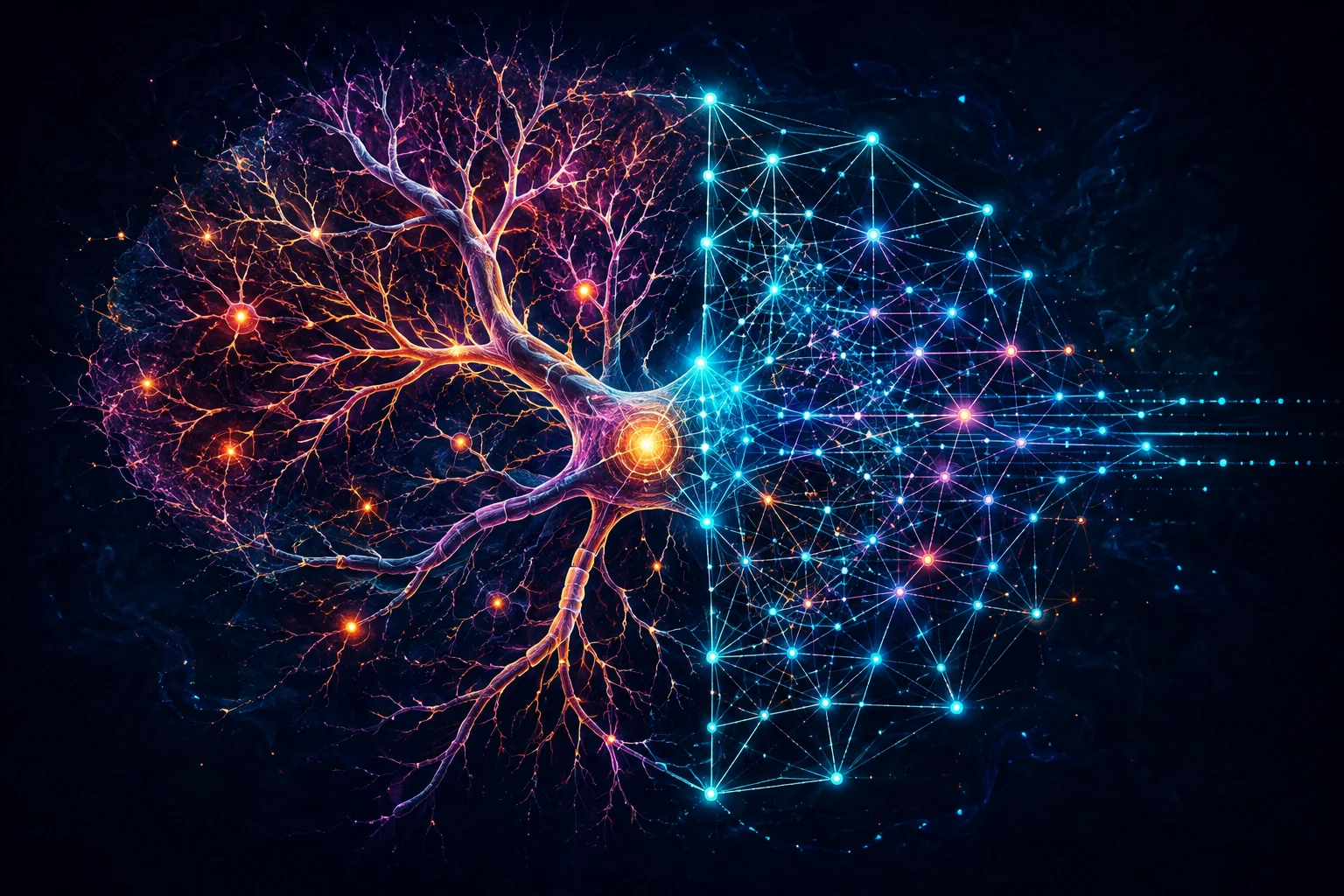
Visual: The atlas illustration brings branching biological neurons beside a geometric artificial network. This is conceptual artwork, not a brain scan.
0:06 Signals are a beginning
Brains use electrochemical signals. Artificial networks transform numbers. Similar diagrams do not make their mechanisms identical.
Visual: Coral pulses pass through a schematic biological circuit. Cyan activity passes through layers of artificial units. The diagrams omit most biological and architectural detail.
0:16 When information travels further
Feedback lets later processing influence earlier activity. Workspace theories link consciousness to information shared across processes.
Visual: A signal enters a feedback loop, reaches a shared workspace, and fans out toward memory, action and report. This illustrates a theoretical architecture, not every brain or AI model.
0:26 Could organization cross materials?
If the right functional organization is sufficient for experience, a non-biological system could, in principle, realize it too.
Visual: Two abstract circuits with corresponding connections light up in matching sequences. They illustrate a conditional functionalist proposal, not demonstrated equivalence between a brain and an AI.
0:36 The causal structure matters
IIT asks about the physical system’s irreducible cause-and-effect structure. A software simulation need not reproduce that physical structure.
Visual: An intact causal network is compared with a partition that removes connections between its halves. This is a conceptual illustration, not an IIT calculation or a measurement of consciousness.
0:46 Plausibility is a research question
Compare theories. Test mechanisms. Keep the uncertainty visible. No feature shown here, by itself, establishes subjective experience.
Visual: The sequence resolves into three steps: theories, mechanisms and tests. The open question remains at the center of the atlas.
0:56 The question stays open
The question stays open. Explore the evidence. The Consciousness Atlas. theconsciousnessatlas.com
Visual: The final diagram gently dissolves into a closing title card. The card holds, then slowly fades to black, leaving a quiet pause at the end.
Scientific foundations: Butlin et al. (2023) and IIT 4.0 — Albantakis et al. (2023). Theories make different predictions; these illustrations do not settle which is correct.
CHOOSE YOUR PATH
A little time. A deeper question.
Three stops in simplified mode. Read the opening explanations at each stop, then follow whatever catches your curiosity.
Selecting a route sets the reading mode. You can change it anytime using the Simplified / Technical switch above.
GUIDED EVIDENCE TRAIL · 5 STOPSCan a model notice a change inside itself?Follow the experiments, challenge the controls, connect the papers.