THE CONSCIOUSNESS ATLAS
AN EXPLORATION OF MINDS & MACHINES

02 / INSIDE THE NETWORKS

Signals become
something more complex.

Biological and artificial neural networks both transform signals. Their mechanisms, physical organization, and learning processes differ substantially.

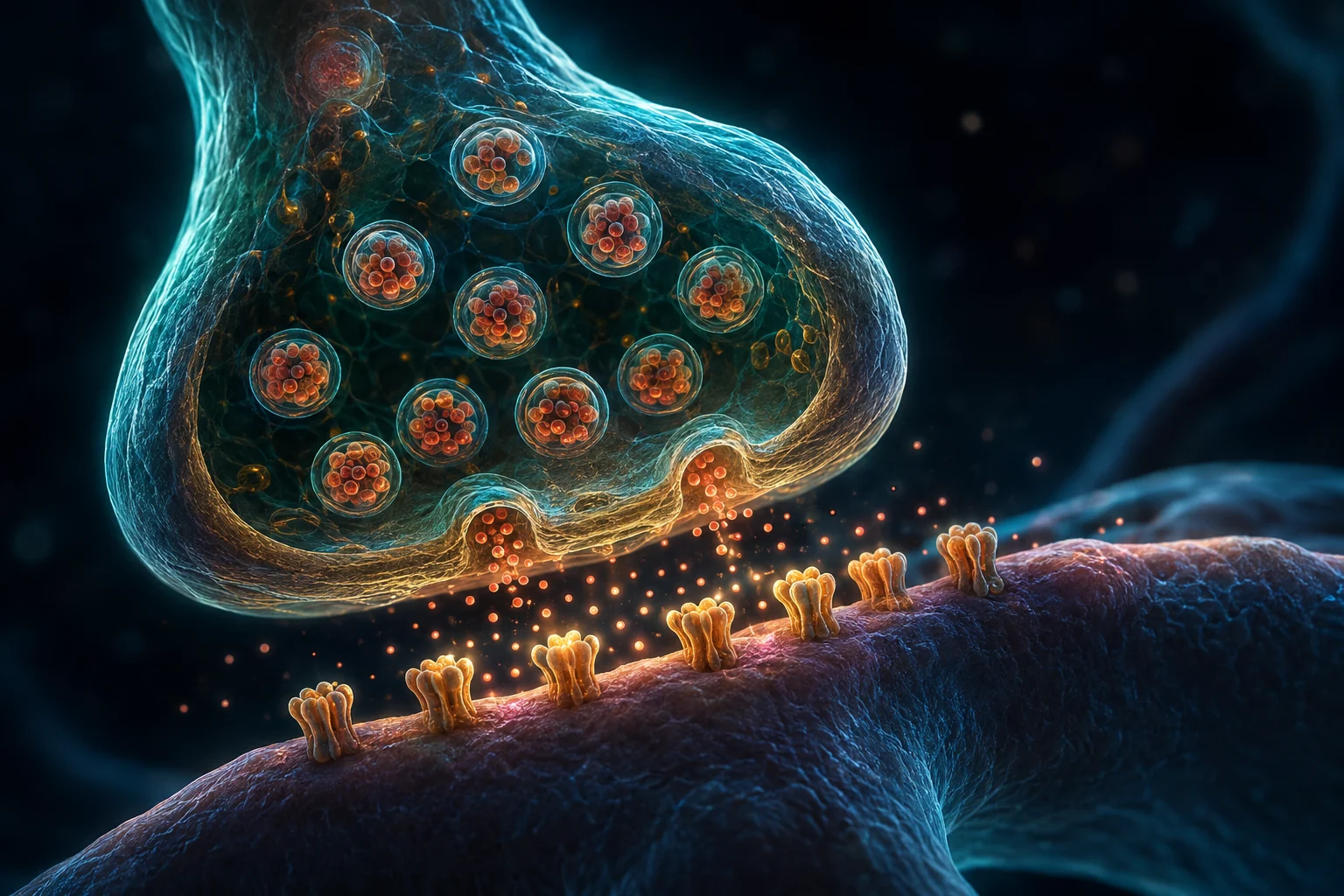
Stylized cutaway: vesicles inside a presynaptic terminal release orange transmitter molecules across a gap toward postsynaptic receptors.
ILLUSTRATION 01 · A chemical synapse. Vesicles above, receptors below. Colors, scale and molecular shapes are illustrative; supporting cells and much of the molecular machinery are omitted.
PROCESS IN MOTION

From pulse to response

1234
  1. 1Electrical pulse
  2. 2Calcium entry
  3. 3Transmitter release
  4. 4Receptor response
A sequence at a chemical synapse. Receptor effects can be excitatory, inhibitory or modulatory; a new spike is not guaranteed.Schematic timing, slowed for clarity.

BIOLOGICAL / ELECTROCHEMICAL

A conversation
between living cells.

  1. 1

    An electrical signal arrives

    A brief electrical pulse travels along a neuron’s axon toward a synapse.

  2. 2

    Chemistry crosses the gap

    Calcium enters the nerve ending, triggering vesicles to release neurotransmitters into the synaptic cleft.

  3. 3

    The next cell responds

    Transmitters bind to receptors. Depending on the receptor and context, they change how likely the next cell is to fire.
Synaptic transmission · Neuroscience
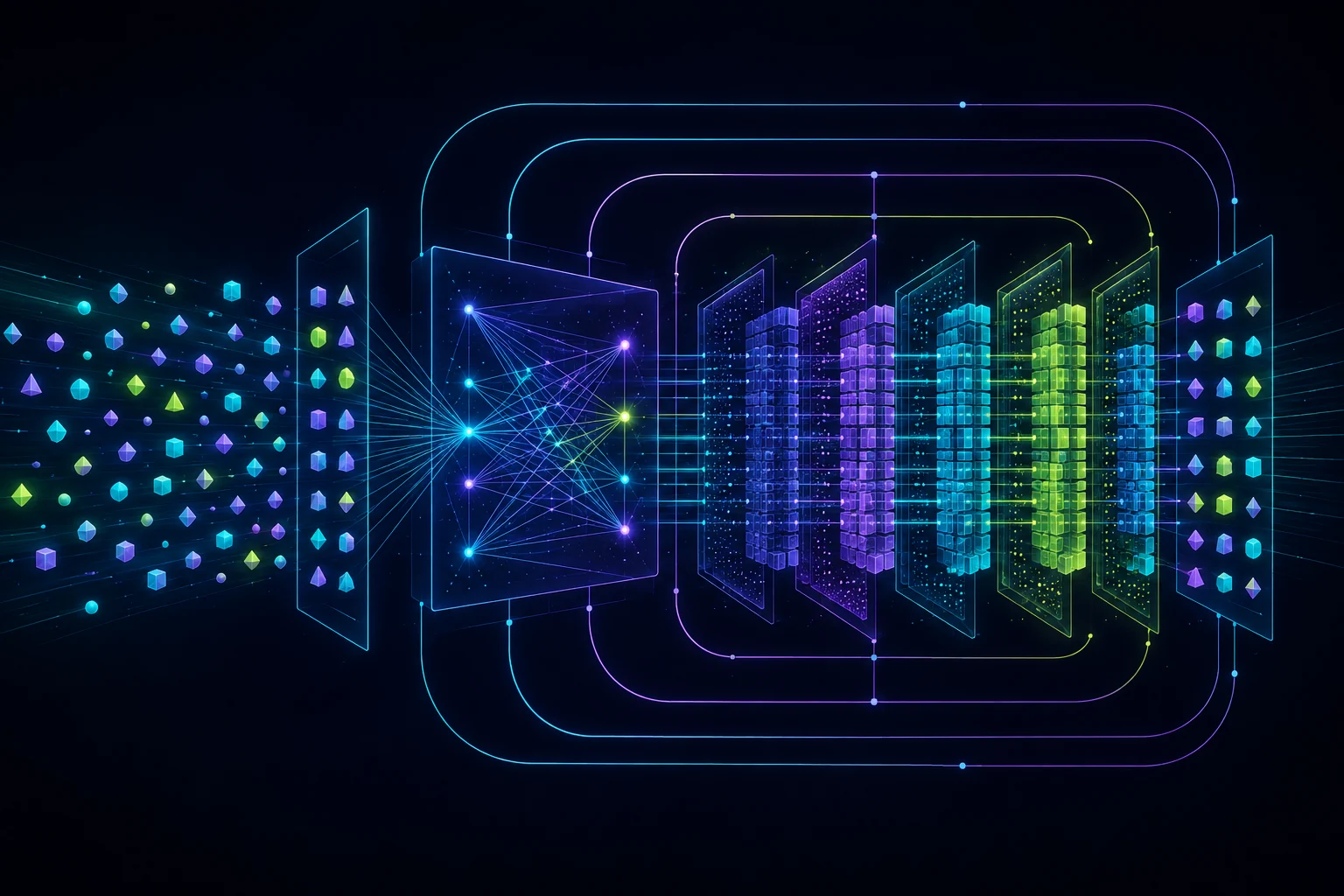
Conceptual transformer illustration: token-like shapes pass through attention connections and layers with curved bypass paths.
ILLUSTRATION 02 · A conceptual view of transformer processing. Blocks and arcs evoke transformations and residual paths; this is not an executable architecture or an actual model’s wiring diagram.
PROCESS IN MOTION

A passage through a transformer

AMATTENTIONMLP
  1. 1Token vectors
  2. 2Attention
  3. 3Transformation
  4. 4Updated vectors
One schematic block: attention mixes token information, then an MLP transforms each position. Upper arcs show residual paths. Normalization and positional details are omitted.Schematic timing, slowed for clarity.

ARTIFICIAL / NUMERICAL

Patterns transformed
through learned connections.

  1. 1

    Turn inputs into numbers

    Text is split into tokens, which become vectors: lists of numbers that represent information the network can work with.

  2. 2

    Combine and transform

    Attention mixes information across token positions. Other layers transform these representations; residual paths carry information around those transformations.

  3. 3

    Produce a prediction

    For a language model, final representations produce probabilities for the next token. Repeating this process generates a response.

Transformer foundations · Vaswani et al., 2017

An artificial “neuron” is a mathematical operation, not a living cell. Transformer attention is an information-routing operation; its name does not imply conscious attention.

Where the comparison is useful—and where it stops.

Connections are only part of the story

A wiring map shows who connects to whom. To understand a working brain, researchers also need to know what its cells are doing and how their interactions change.

MICrONS, 2025

Learning is not one universal mechanism

Brains adapt through many forms of biological plasticity. Digital networks usually learn by adjusting numerical weights to reduce a training error. A useful analogy does not make them identical.

Connectivity and function, 2025

Feedback needs a precise definition

Generating a new word using earlier words creates a kind of loop. That alone does not establish the brain-like feedback or workspace required by a consciousness theory.

Architecture and indicators, 2023