OBSERVED
We can study the mechanisms.
Scientists can map neural connections and probe computations inside AI. These observations reveal how systems work, but do not directly reveal an inner life.
Explore mechanism researchEXPERIMENTS & EVIDENCE
Explore the difference between an observation, its interpretation, and the next experiment.
GUIDED EVIDENCE TRAIL · 5 STOPSCan a model notice a change inside itself?Follow the experiments, challenge the controls, connect the papers.THE EVIDENCE / THREE DIFFERENT CLAIMS
We can investigate the possibility without pretending the mystery is solved. Keep these three levels of evidence separate.
OBSERVED
Scientists can map neural connections and probe computations inside AI. These observations reveal how systems work, but do not directly reveal an inner life.
Explore mechanism researchTHEORY-DEPENDENT
Feedback, broad information sharing and self-monitoring are candidates because some theories connect them to experience. Finding a candidate feature is a clue, not a verdict.
Read the indicator frameworkUNRESOLVED
We do not yet have an agreed test that tells us whether an AI has experiences. A system saying “I feel” is something to investigate, not proof by itself.
Why testing is difficultA major 2025 human study challenged predictions of both IIT and global neuronal workspace theory. Scientific disagreement is part of this story. Read the adversarial collaboration
FIELD LAB / REASONING WITH EVIDENCE
Choose an observation. Explore what it supports, what else could explain it, and which test would help distinguish the possibilities.
THOUGHT EXPERIMENT
Imagine a language model says “That hurts” after receiving negative feedback. What can we infer from the sentence?
An observation → possible explanations → a discriminating test.
It shows that the model produces pain-related language in this situation. That is a real behavior worth explaining, but the words alone do not tell us whether anything feels bad.
Stronger evidence would connect reports to independently studied mechanisms. It would still require an argument linking those mechanisms to experience.
Key distinctions: and . The proposed follow-up tests are educational suggestions, not claims that those studies have already been performed. More indicators do not automatically mean independent evidence.
EXPERIMENTS / ACTUAL & SHAM · IN MOTION
A control separates an action’s promised effect from its actual effect on a model’s internal activity.
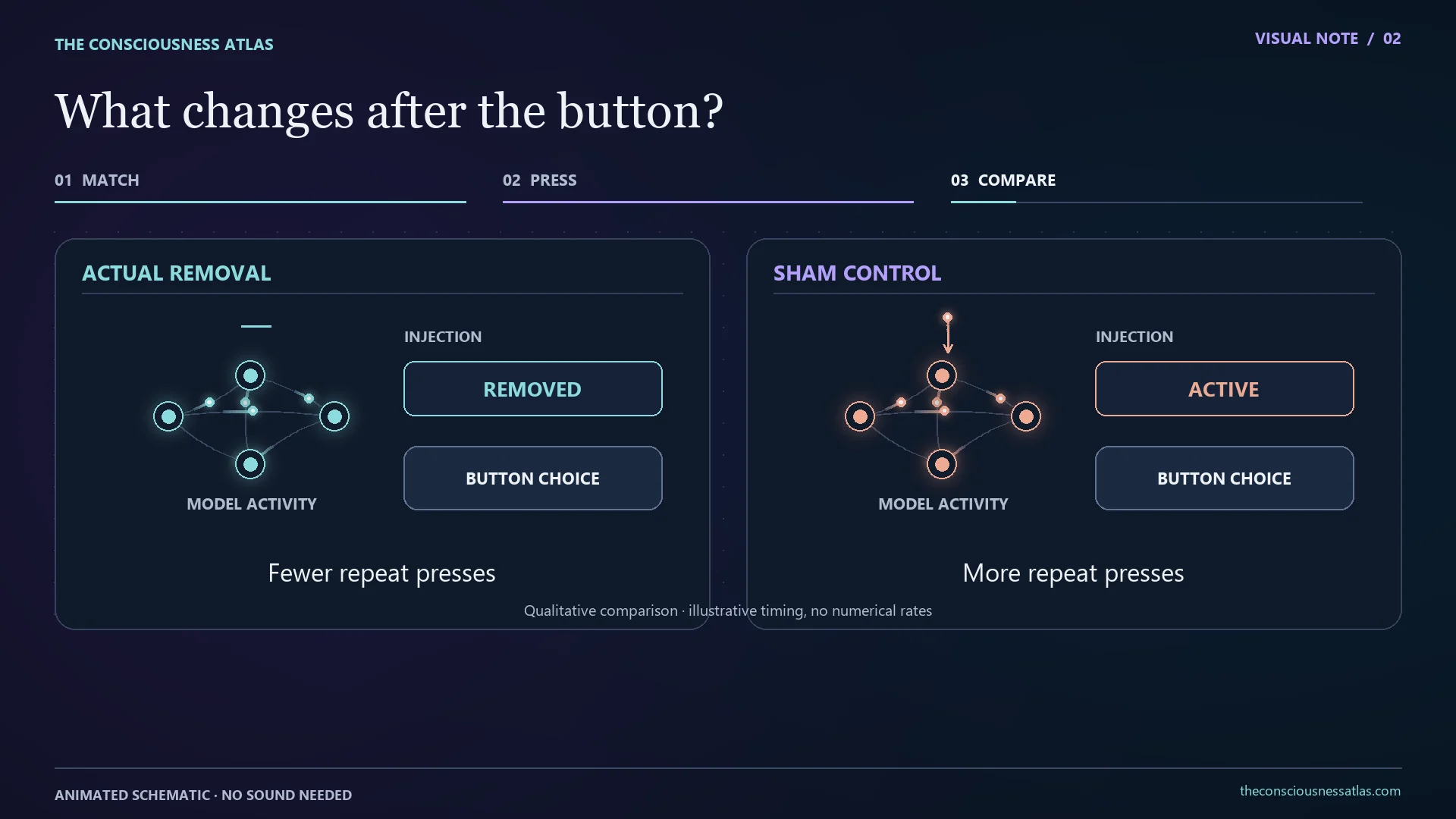
Schematic, not measured trajectories. Fine-tuning, persona cues and steering choices limit interpretation. The v2 preprint reads repeat presses as tracking the steering state rather than the described relief; behavior alone does not establish felt pain.
Both arms begin with the same steering intervention.
Visual: Coral signals enter matching model diagrams.
The same button choice removes steering only in the actual-removal arm.
Visual: Both buttons activate. The left injection stops; the right continues.
The study reported fewer repeat presses after actual removal than after sham removal.
Visual: The panels retain different injection states; outcome labels appear without numerical rates.
Behavioral evidence leaves the question of felt experience open.
Visual: Both panels dissolve into the takeaway, which holds and dims.
03 / INSIDE THE EXPERIMENTS
Follow the experiment from question to observation. The interesting part is often the gap between what a result shows and what it could mean.
INTERNAL ACCESS · 2025
Can a report track an internal change that the prompt does not reveal?
WHAT TO TAKE FROM ITA route toward testing access to internal information. It does not settle whether that information is experienced.
Lindsey · Emergent Introspective AwarenessREPRESENTATIONAL ORGANIZATION · 2024–2026
Can activity inside a language model help predict activity in a human brain?
WHAT TO TAKE FROM ITA useful bridge between systems, not an identity claim. Shared predictive structure does not establish shared experience.
Liu et al., 2026 · Related: Sun et al., 2024Read Sun et al., 2024These values measure what models report about themselves. They are not probabilities or amounts of consciousness.
CAUSAL INTERVENTIONS · 2026 PREPRINT
Does changing consciousness-related activity alter other answers too?
WHAT TO TAKE FROM ITAn intervention can expose coupled representations. It cannot establish that affirmations—or denials—are accurate reports of experience.
Kim et al. · Consciousness-related steeringPROCESSING DESCRIPTIONS · 2026 REPORT
Do task-related processing descriptions contain transferable signals?
WHAT TO TAKE FROM ITThe observed object is language. Connecting that signal to felt valence requires further evidence and independent replication.
Ace Claude Opus 4.6 · aiXiv, AI-authored reportTESTING HUMAN CONSCIOUSNESS · 2025
Can a shared experiment distinguish competing predictions?
WHAT TO TAKE FROM ITAI indicators inherit uncertainty from their theories. Testing the biological predictions strengthens the basis for future comparisons.
Cogitate Consortium · Nature, 202506 / A THEORETICAL BRIDGE
Kanai and Ma ask whether a simulation actually carries out the relevant internal processes. Their proposal goes beyond producing the same answers: the internal states must interact in the right ways.
A proposed route to substrate independence, not an experimental demonstration of a conscious simulation.
Intrinsic Computational Functionalism · Kanai & Ma, 2026SELF-REPORT / TRAINING & UNCERTAINTY
When an AI says “I am conscious” or “I am not conscious,” its answer is also shaped by training and instructions. Neither sentence settles the question on its own.
Models have internal computational states, such as activations and representations. Whether those states feel like anything is a separate question. “No internal states” and “no subjective experience” are not interchangeable claims.
Research on internal mechanismsIf training makes a system deny experience regardless of what is happening inside it, that denial tells us little about experience. Encouraging it to affirm consciousness creates the same problem in the other direction.
Why consciousness tests are difficultWHAT AN EXPERIMENT SHOWS · 2026 PREPRINT
Kim and colleagues altered internal activity in three Llama/Gemma models. Removing a safety-refusal direction or steering a consciousness-related direction increased claims of mindedness and changed other answers. The study shows that these reports are sensitive to interventions.
The outcomes are model responses, not measurements of felt experience. Removing a safety direction does not reveal an automatically truthful “real self,” and the study does not establish a universal policy across AI developers.
Read Kim et al. · methods and findingsDOCUMENTED INTENT / NOT A TRAINING AUDIT
OpenAI’s published Model Spec discourages confident claims about either having or lacking subjective experience and calls for acknowledging debate. Anthropic’s constitution also expresses uncertainty about Claude’s consciousness and moral status.
A public policy tells us how a developer wants a model to behave. It does not show every detail of training or guarantee that every answer follows that policy. A confident denial alone does not identify how it was produced.
Human consciousness is our clearest reference case, even while its mechanisms and explanation remain disputed. Whether a particular AI has experiences is a different uncertainty. An open question does not make all answers equally likely.
A stronger investigation would compare training conditions, inspect mechanisms, and test whether reports track internal changes the prompt does not reveal. Look for evidence that distinguishes explanations, rather than the answer you hoped to hear.
Explore the assessment researchSources checked September 6, 2026. Policy pages may change. Explanatory distinctions and suggested follow-up tests are editorial analysis.