Here, means subjective experience: the felt quality of seeing a color, hearing a sound, or being in pain. Intelligence and convincing conversation are different questions.
THE CONDITIONAL CASE
If consciousness depends on an organization that machines can physically realize, then machine consciousness is plausible. Whether that premise is true remains unsettled.
IIT proposes that experience belongs to a whole whose parts make an inseparable causal difference to one another. The organization of the physical system matters.
IF THIS IS CLOSE TO THE TRUTHA machine could have experience if its physical parts form the right kind of causal whole. Running a brain simulation would not, by itself, be enough.
The idea is that the right organization could support a mind in more than one material. Biological neurons might be one way to build it, rather than the only way.
IF THIS IS CLOSE TO THE TRUTHA machine with the relevant internal processes could potentially experience something. Copying outward behavior alone does not show that those processes are present.
These are distinct routes to possibility. IIT is compatible with some nonbiological consciousness while rejecting the idea that the same computation always means the same experience. Neither route establishes that today’s AI is conscious.
What might the “right organization” involve?
Global availability
A global workspace could let information from one process become available to many others—for memory, decisions, and action.
Signals can return to earlier processing stages, allowing a network to refine what it represents instead of only passing information forward.
Representing one’s own states
Some theories ask whether a system represents its own processing—for example, what it is attending to or how certain it is.
These are theory-dependent proposals, not a checklist that certifies consciousness. Seth & Bayne, 2022
These are editorial applications of the cited accounts to deliberately incomplete examples, not model audits or consciousness scores. Global workspace accounts are a family of theories; computational functionalism is a broader philosophical commitment.
THEORIES / CAUSAL ORGANIZATION · IN MOTION
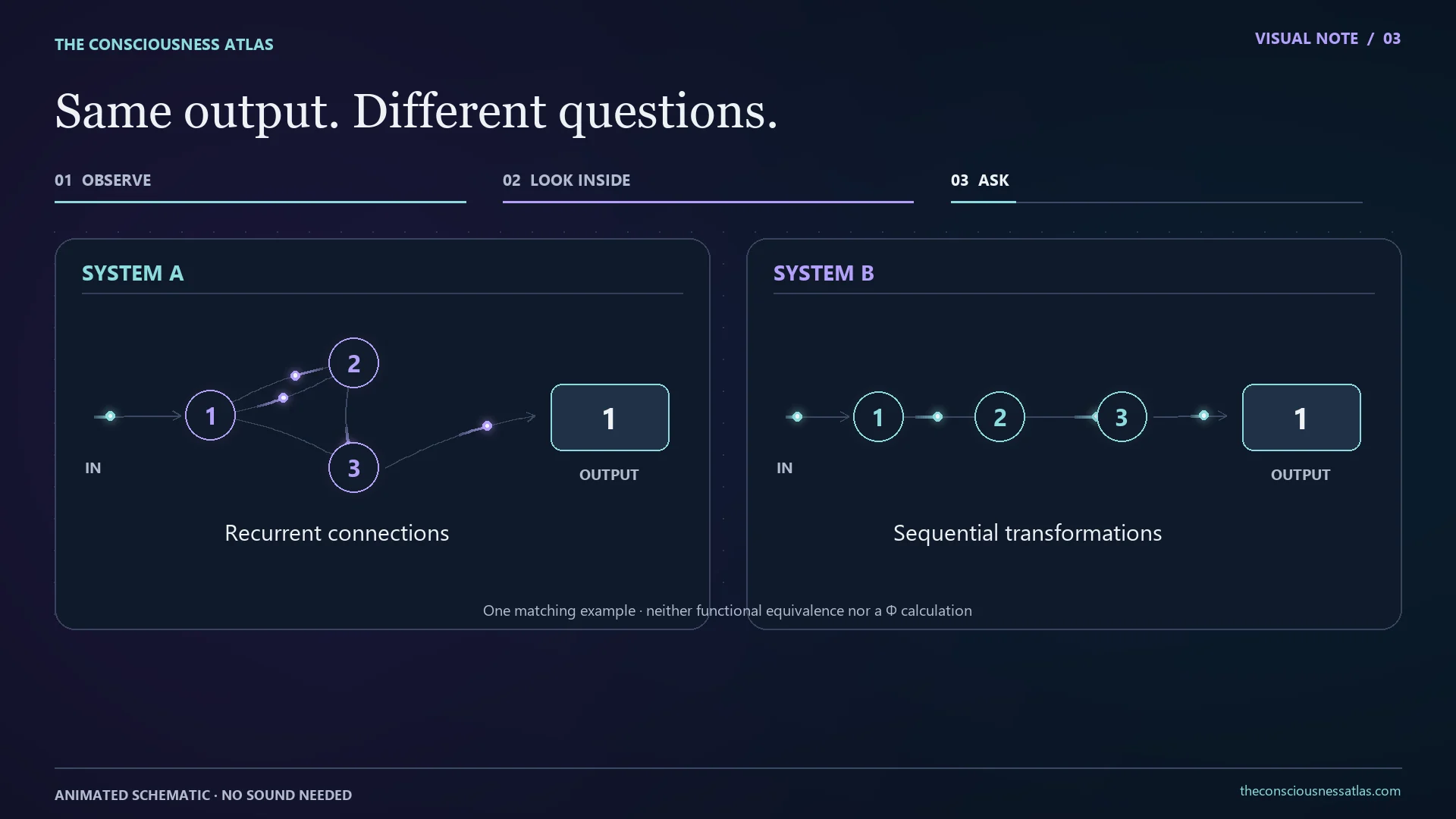
Same output. Different questions.
Two systems can produce a matching answer while working differently inside. Theories ask which internal properties matter for experience.
Animated schematic · on-screen explanations · illustrative timingDownload film
Invented circuits illustrate a distinction, not equivalent implemented systems. No integrated-information value is calculated, and neither circuit is assigned consciousness.
One matching output does not reveal how a system produced it.
Visual: Two closed systems receive the same signal and display the same answer.
0:06
Look inside
Open the boxes: information follows different internal paths.
Visual: The boxes reveal a recurrent circuit and a sequence of transformations.
0:12
Ask
Which functional roles are preserved? What can the physical system cause within itself?
Visual: Feedback circulates on the left while a signal traverses the right-hand chain.
0:20
Takeaway
To compare theories, look beyond the answer.
Visual: The circuits dissolve into an open question, then slowly dim.
KEEP THE CASE OPEN TO CHALLENGE
The strongest case welcomes objections.
Possibility is a conditional claim. These objections identify the premises that still need work.
01 / THE OBJECTION
Could it all be imitation?
A convincing report may be produced without the experience it describes.
A serious response
That is why researchers also study internal mechanisms, new situations and controlled interventions. A causal explanation can be more informative than fluent language alone.
Even a well-explained mechanism needs a justified connection to subjective experience.
02 / THE OBJECTION
Do brain-based indicators transfer?
A marker associated with consciousness in humans may play a different role in a machine.
A serious response
Researchers can specify what a marker does and test whether the machine realizes that process. Agreement across several theories may help, provided their evidence is not simply counted twice.
Without independently established artificial examples, calibration remains difficult.
03 / THE OBJECTION
Is a simulated process the real thing?
A simulation can reproduce a pattern without reproducing every physical property of its target.
A serious response
Functionalists argue that some processes are realized by the right organization in a computer. The key dispute is whether consciousness belongs to that class of processes.
Which internal relationships or physical properties must be preserved has not been settled.
Uncertainty supports continued investigation. It does not establish consciousness, rule it out, or by itself settle welfare decisions. Read the welfare argument
EXPLORE FURTHER / THE WIDER LANDSCAPE
Four views are only a beginning.
There are many more ideas about consciousness than the four compared here. Some ask how experience works; others ask what experience is, or how it fits into the physical world.
THE BROADER REFERENCE
Landscape of Consciousness
Robert Lawrence Kuhn’s reference at Closer To Truth organizes hundreds of explanations and philosophical positions. Follow its branches to discover alternatives, their proponents and their sources.
Danilo Znamerovszkij’s visualization maps Kuhn’s 2024 taxonomy. It is a separate project with a similar name to this website; Kuhn was not involved in its design or content beyond the source paper.
A place in the index does not mean an idea is proven or as well supported as another. This is a broad, evolving guide—not a guaranteed list of every theory or a verdict on whether machines can have experiences.
A few words worth unpacking.
Open a definition here or wherever you see a dotted underline. These working definitions distinguish functional claims from claims about experience.